

Pan-Canadian Health Data Content Framework products
The products of the Pan-Canadian Health Data Content Framework (PCHDCF) represent a comprehensive health data content standard with common data architecture for Canada’s health data.
The standard follows a predictable annual publishing cycle to ensure it remains current and continues to meet evolving health system needs.
- September: A draft version of the standard is published.
- September to November: A 60-day open review period seeks feedback on every aspect of the national data standard.
- March: The final version of the CACDI is published, incorporating feedback received during the open review period.
The cycle then repeats each year, supporting continuous improvement and ongoing evolution of the standard.
A core set of guiding principles are used to ensure that the data elements, terminologies and semantic data model are person-centred, collaboratively developed and underpinned by high-quality data stewardship, strong governance and widespread interoperability:
Person-centred with a multi-user design: Meet the needs of diverse users, ensuring accessibility and benefit for health care providers, people receiving care, families and caregivers, administrators and health system planners.
Inclusive: Design with consideration of the voices of populations, groups or peoples historically excluded due to past and ongoing policies and practices.
Respectful of First Nations, Inuit and Métis data governance principles and self-determination: Respect rights, priorities and self-determination of First Nations, Inuit and Métis Peoples by recognizing Indigenous authority in the governance, stewardship, collection, use and sharing of data. Data standards should be co-created and applied in ways that are distinctions-based, culturally relevant, and responsive to Indigenous priorities, values and aspirations.
Iteratively developed: Continuously improve and refine the Pan-Canadian Health Data Content Framework through feedback and adaptation to emerging needs.
Collaborative through broad partner participation: Engage a wide range of partners to ensure the Pan-Canadian Health Data Content Framework is comprehensive, well-informed and reflective of diverse perspectives.
Managed with strong data governance: Maintain data integrity and reliability through clear policies and procedures for accurate, consistent and secure data management, while upholding Indigenous data governance principles.
Integrated with cohesive data stewardship for high data quality: Facilitate seamless data integration across systems, ensuring responsible and effective data management throughout its life cycle.
Driven for multiple use and the reuse of data: Design the Pan-Canadian Health Data Content Framework to support various applications, maximizing data value and promoting innovative uses.
Consistent across Canada and interoperable across systems: Ensure interoperability across different provinces, territories and health care systems — supporting national data harmonization — and alignment with international standards, while respecting Indigenous data sovereignty frameworks.
Connected Care is a future where people do not have to repeat their story, where health information is shared appropriately across the continuum of care and services, and where providers have access to the information they need to support safe, coordinated and person-centred care.
For First Nations, Inuit and Métis Peoples, achieving this vision requires more than connecting systems and information. Connected Care must be built on a foundation of Indigenous data sovereignty, recognizing the inherent rights of Indigenous Peoples to govern information about themselves, their communities and their Nations in ways that reflect their priorities, values and approaches to health and wellness. This commitment is reflected in initiatives such as the Pan-Canadian Health Data Charter, which recognizes the importance of Indigenous data sovereignty and Indigenous-led governance.
Across Canada, governments and health organizations are collaborating with First Nations, Inuit and Métis partners to strengthen Indigenous self-governance of health information and enable the trusted sharing and use of data. This work includes developing governance frameworks, establishing data-sharing agreements, investing in First Nations, Inuit and Métis-led digital health infrastructure, and ensuring that national interoperability initiatives reflect First Nations, Inuit and Métis priorities. These interoperability initiatives take a distinctions-based approach and align with Indigenous data governance principles, including Ownership, Control, Access and Possession (OCAP®), Métis Ownership, Control, Access and Stewardship (OCAS), and Inuit-led approaches such as Inuit Qaujimajatuqangit (IQ). Increasingly, these initiatives are being designed to support Indigenous governance rather than override it.
The Pan-Canadian Health Data Content Framework is one example of this approach. This health data standard has been co-designed with First Nations, Inuit and Métis partners, along with health care providers, health leaders, information governance experts and community members through co-contributor groups. First Nations, Inuit and Métis partners inform the development of Indigenous-specific data elements and value sets, as well as the standard's core, sector- and setting-agnostic components, to ensure they align with First Nations, Inuit and Métis priorities. These partners also provide ongoing guidance on the respectful governance of Indigenous data throughout the development process.
This national data standard aims to support the provision of culturally safe care by applying a distinctions-based approach to data standardization and helping ensure that health information can be shared consistently while respecting the unique governance, priorities, and perspectives of First Nations, Inuit and Métis Peoples.
CIHI’s Connected Care initiative is guided by the following key principles for First Nations, Inuit and Métis data:
- Recognize Indigenous data sovereignty.
- Enable Indigenous governance and decision-making.
- Practice distinctions-based approaches.
- Co-design interoperability in service of Indigenous governance.
- Invest in Indigenous digital health capacity and infrastructure.
Together, these efforts are helping to create a Connected Care ecosystem that supports First Nations, Inuit and Métis self-determination and self-governance of health information. When communities can trust health information systems, see value in how data is used, and use their own information to inform planning and service delivery, Connected Care can support more culturally relevant, responsive and community-driven care.
We extend our sincere gratitude to the individuals and organizations who contributed to the development of the Pan-Canadian Health Data Content Framework. This collaborative effort would not have been possible without the support and expertise of key organizations, including the following:
- Accenture
- Aeon Health
- Alberta Health
- Alberta Health Services
- Alliance for Healthier Communities
- Amplify Care
- Better Outcomes Registry & Network — Ontario
- British Columbia Ministry of Health
- Canadian Association of Radiologists
- Canada Health Infoway
- Canada’s Perinatal Programs Coalition
- Canadian Nurses Association
- Canadian Pharmacists Association
- CGI
- CIUSSS Centre-Ouest-de-l’Île-de-Montréal
- College of Family Physicians of Canada
- Constable Consulting
- eHealth Centre of Excellence
- EPIC
- Health Canada
- Health Data Coalition
- HL7 Canada Council
- Intelerad Medical Systems
- Intrahealth Canada Limited
- Island Health
- LCI Health — Laroche Consulting
- MEDITECH
- Mustimuhw
- Nizamov Consulting
- Nurse Practitioner Association of Canada
- Ocean MD
- Ontario Health
- OntarioMD
- Ontario Ministry of Health
- Oracle Canada
- Patient Voices Network
- Petal
- Philips Medical Systems Canada
- Point Click Care
- Provincial Health Services Authority (B.C.)
- Pyke Health IT Inc.
- Public Health Agency of Canada
- QHR Technologies
- Shared Health Manitoba
- University of Ottawa
- Upstream Lab
- Vigilance Santé
We would also like to give special acknowledgment to the people with lived and living experience, providers, researchers, Indigenous partners, provincial and territorial governments, policy-makers and data architects who offered invaluable insights and feedback throughout the development process. Their contributions have been instrumental in advancing the Pan-Canadian Health Data Content Framework and ensuring it meets the diverse needs of Canada’s health care landscape.
What health data does this national data standard cover?
This national data standard aims to reflect comprehensive, coordinated and integrated care provided by interdisciplinary teams to address population health, health promotion and disease prevention, chronic disease management and community health.
The scope of version 3 covers the following categories: Person information, Medication, Allergies and Intolerances, Health Concerns, Immunization, Social Determinants of Health, Care Team, Health Care Provider Information, Encounter; Organization, Family History, Procedures, Clinical Documents, Vital Signs, Substance Use, Medical Devices and Equipment, Medical Imaging, Laboratory, Service Request, Perinatal Health and FNIM Determinants of Health Future content will build on these categories as illustrated in the image below.
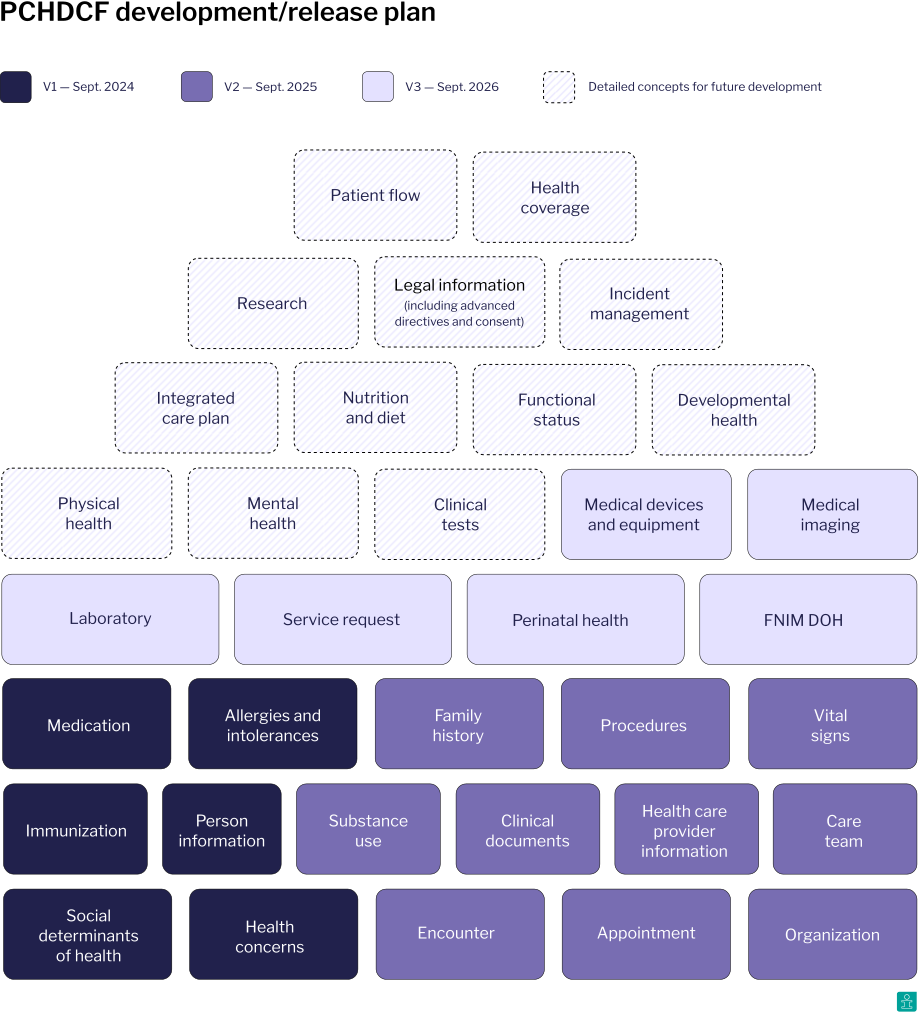
This diagram shows categories of the Pan-Canadian Health Data Content Framework and when they were or are to be released.
Categories in Version 1 — September 2024 include:
- Medication
- Allergies and intolerances
- Immunization
- Person information
- Social determinants of health
- Health concerns
Additional categories in Version 2 — September 2025 include:
- Family history
- Procedures
- Vital signs
- Substance use
- Clinical documents
- Health care provider information
- Care team
- Encounter
- Appointment
- Organization
Additional categories in Version 3 — September 2026 include:
- Medical devices and equipment
- Medical imaging
- Laboratory
- Service request
- Perinatal health
- FNIM determinants of health
Future releases will expand coverage to include:
- Patient flow
- Health coverage
- Research
- Legal information (including advance directives and consent)
- Incident management
- Integrated care plan
- Nutrition and diet
- Functional status
- Developmental health
- Physical health
- Mental health
- Clinical tests
The national data standard has been developed in alignment with internationally recognized standards and best practices, including the International Patient Summary (IPS), while addressing the needs of the Canadian health system.
Find the information you need
| If you need to… | Use these products |
|---|---|
| Understand the broader work the national data standard is a part of | Connected Care |
| Learn how CIHI’s work on Connected Care brings people and organizations together to create one common national health data standard. | |
| Understand the business context, terms and definitions to create a shared understanding of health data and digital health concepts | Business Context Model |
| Defines the scope, people, organizations and systems that influence, collaborate on, inform and consume the Pan-Canadian Health Data Content Framework. | |
| Business Glossary | |
| Provides standardized terms, definitions and relationships to support a shared understanding of health and digital health concepts | |
| Understand the health information that is covered in the national data standard | Information Model |
| Organizes health concepts into subject areas and illustrates how those concepts relate to one another. | |
| Data Elements and Terminologies | |
| Defines the essential data content necessary for a national data standard. It specifies the types of data to be collected, such as diagnoses, and the languages and formats to be used, such as SNOMED CT codes. | |
| Learn about the Canadian Core Data for Interoperability (CACDI), the subset of the national data standard | CACDI Data Elements and Terminologies |
| A core set of standardized health data elements and value sets that support interoperability across Canada's health systems. | |
| CACDI Semantic Common Data Model | |
| A structured representation of CACDI concepts, classes, attributes and relationships that supports implementation and information flow. | |
| Learn about how the national data standard enables quality data and semantic interoperability | Business Rules |
| Defines constraints and requirements that support data quality, consistency and semantic interoperability. | |
| Use Cases | |
| Demonstrates how health information is created, exchanged and used through real-world clinical scenarios. | |
| Understand how the national data standard uses a semantic common data model | Semantic Common Data Model |
| A semantically rich model that represents and standardizes key health concepts and supporting information concepts, as well as describing how they relate to each other. | |
| Common Data Model Implementation Guide | |
| Provides guidance and considerations for implementing the Semantic Common Data Model. | |
| Metamodel | |
| Shows how all Framework products are structured and how they relate to one another. |
Contact us
If you have questions about this initiative, would like to be added to our stakeholder notification list or would like to participate in our consultations, please email us.
